
Hair Loss Nutrition: The Reasons And Solutions

Have you ever wondered why losing hair feels like losing a piece of yourself? The answer is deep in biology and primary instincts. From an evolutionary perspective, beauty was never aesthetic. It is a biological signal, a subconscious shorthand for health and fertility that guided partner selection for thousands of generations. And throughout human history, long, thick, lustrous hair in women has sat near the center of that signal.
The reason is what biologists call the “good genes” idea: hair is slow to grow and “expensive” for the body to maintain, so a full, glossy head of it acts as a visible billboard advertising that the body underneath has been well fed and well cared for a long time. That is why hair loss lands so hard. Call it vanity, because it is, but underneath it is something far more ancient: a wiring that reads thinning hair as a falling health status report.

For some reason, I always tried to find the reasons behind the problem. So when a client was sitting in my chair, telling me their hair was falling out, I was never just looking at hair. I was looking at biology, trying to say something. Hair loss nutrition is the study of what it is trying to say, and it sits in a strange blind spot: the salon sells you a hair loss shampoo, volumizing mousse, the pharmacy sells you a supplement, and almost nobody connects the strand on the floor to what is, or isn’t, on the plate.
I spent 33 years behind the chair watching the same patterns repeat, intrigued by why hair mattered so fiercely to the women it happened to.
Then I went back to university to study nutrition, and finally understood what I had been looking at the whole time. This is the long version: the part the gummy bottle leaves off.
The Hair Growth Cycle: Why a Follicle Is a Tiny Factory
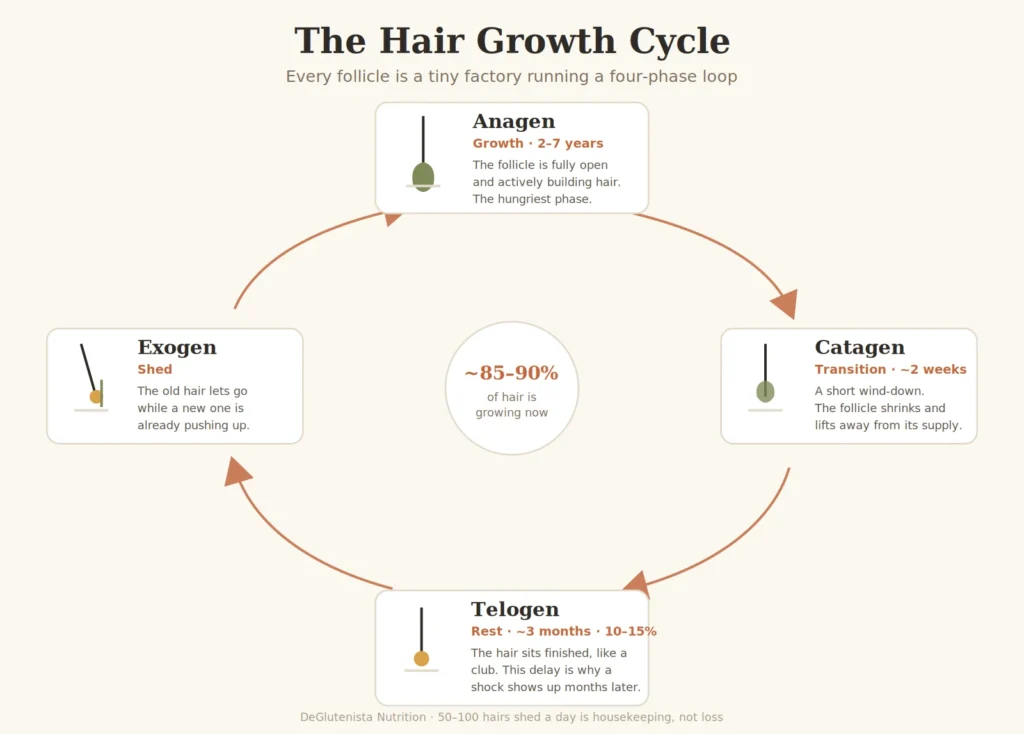
Before we talk about food, you need to know what you are feeding. Every hair on your head grows from a follicle, and every follicle runs on a cycle with four phases.
- Anagen is the growth phase, the years-long stretch where the follicle is actively building hair, sometimes for two to seven years at a time.
- Catagen is a short wind-down of a couple of weeks.
- Telogen is the resting phase, around three months, where the hair just sits there, finished.
- Exogen is the moment it lets go and falls, while a new hair is already pushing up underneath.
At any given moment, roughly 85 to 90% of your hair is in anagen, and about 10 to 15% is in the resting phase. Losing 50 to 100 hairs a day is not a loss; it is normal housekeeping.
Here is the part nobody tells you. The cells at the base of an anagen follicle, in the hair matrix, are among the fastest-dividing cells in the entire human body. A follicle in full growth is a factory running three shifts, and a factory that is busy needs raw materials delivered constantly: iron, protein, zinc, energy.
When the supply chain gets thin, the body does something coldly sensible. It does not shut down your heart or your brain to save resources. It shuts down the factory it can most afford to lose. Hair is, biologically, a luxury. It is the first thing switched off when the budget tightens, and the last thing switched back on when things recover.
That single fact reframes most of what people get wrong about hair loss. Your hair isn’t betraying you so much as reporting on you.
Why Hair Falls Out Months After Stress: Telogen Effluvium
This is the single most reassuring thing I learned, and the one that stopped the most women in my chair from spiraling.
When your body gets a real shock, a high fever, a bad bout of flu, surgery, a crash diet, childbirth, a genuine emotional crisis, it can push a large batch of follicles out of growth and into the resting phase all at once. This is called telogen effluvium. But here is the cruel timing: telogen lasts about three months. So you do not shed at the moment of the shock. You shed two to four months later, when those resting follicles all let go together.
This is why so many women come to me convinced something is wrong right now, in October, when the real culprit was the flu they had in July, or the surgery in spring, or the baby born in winter. They have been feeling well for weeks. The hair is on a delay. It is showing you the “weather” from three months ago.
I know, a heavy shedding that starts two to three months after a known stressor and is diffuse across the scalp is, in the vast majority of cases, temporary. The follicles are not dead. They are reset. Believe me on this one: the most useful thing you can often do is rule out a deficiency, support the body, and wait for the cycle to turn.
Traction Alopecia: The Tight-Bun Hair Loss I Watched Creep Up on Women
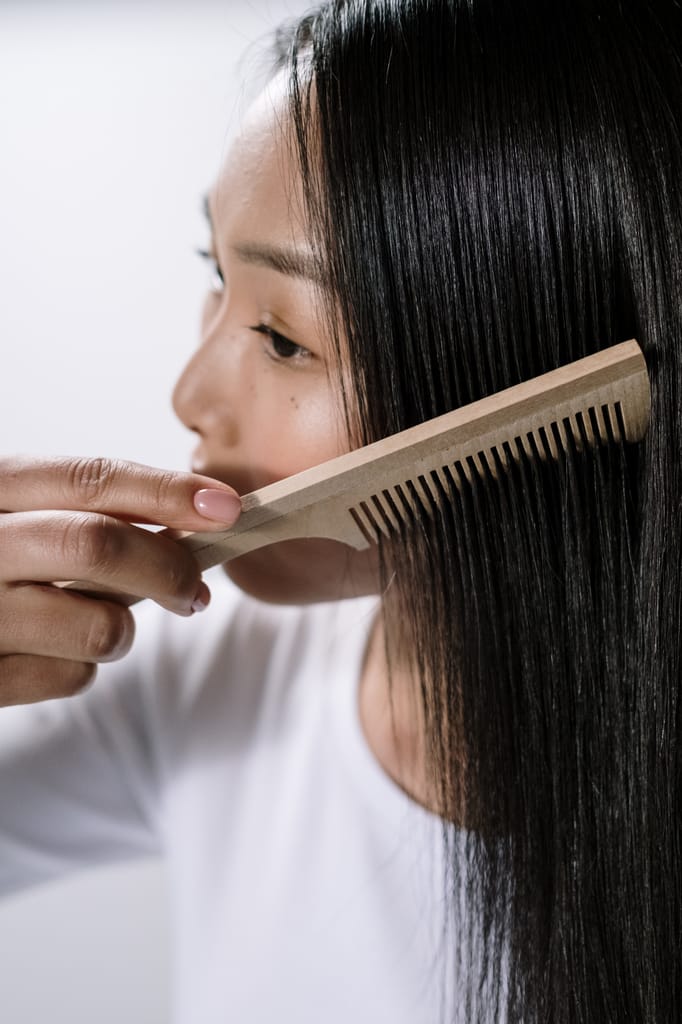
There is one kind of loss that has nothing to do with hair loss nutrition, and I saw it more often than almost any other, usually in the women proudest of their hair. It is called traction alopecia, and dermatologists sometimes call the classic version “ballerina alopecia,” because dancers wear it written into their hairline. This condition can be seen in sportspeople as well as professionals for whom hair up is required.
The pattern is heartbreakingly logical: a woman loves her long hair, finds it heavy and hard to manage, so she scrapes it back into a tight bun or ponytail day after day, year after year. The constant pulling on the same follicles, right at the hairline and temples, slowly drags them out. The hair she was trying so hard to protect is the very hair she loses first.
Here is the part I begged my clients to hear in time. Early on, traction alopecia is completely reversible: loosen the style, give the follicles a real rest, and the hair comes back. But if the tension goes on for years, the follicle scars over, and a scarred follicle is gone for good. No oil, no supplement, no serum brings it back, only a hair transplant.
So if you wear your hair up tightly and you are seeing a thinning, receding line at your temples, or your scalp aches when you finally let it down, treat that as the early warning it is. Wear it loose, vary where the tension sits, and protect the hairline now, while the follicles are still alive to save.

Hair Loss Nutrition: The Deficiencies That Show Up in the Strand First
Because hair is the first factory the body stops supplying, nutrient shortfalls often announce themselves in your hairbrush before they show up anywhere else. This is the heart of hair-loss nutrition, where you have real leverage. My ex-clients can hear me now. What are the best foods for hair growth?
Iron (and specifically ferritin). The big one for women, and it gets its own section below.
Protein. Hair is roughly 90% keratin, a protein packed with sulfur-rich amino acids. If your protein intake drops too low for too long, whether through illness, a restrictive diet, or simply years of skipping it at breakfast, the factory runs short on its primary building block. This is one of the quietest causes of thinning in women who eat “healthily” but accidentally eat very little protein.
Zinc. A cofactor in the enzymes that build and repair the follicle. Genuine deficiency is linked to shedding, and it shows up more often in people with gut absorption problems, which is a thread we will pull on shortly.
Vitamin D. The follicle has vitamin D receptors and appears to use the vitamin to help start a new growth cycle. Low levels are commonly found alongside hair loss, though, in the spirit of honesty, association is not proof of causation.
Biotin. The one on every bottle. Here is the unglamorous truth: genuine biotin deficiency is rare, and unless you actually have it, more biotin does very little for your hair. It will, however, skew your thyroid and other blood tests and send your doctor down the wrong road. Those hair-and-nails gummies are almost pure biotin, which means they are selling you a fix for the thing least likely to be wrong with you.
Two specific, surprising facts to keep in your back pocket.
First: you can have a completely normal blood iron panel and a normal hemoglobin, and still be running on empty for hair, because your iron stores are depleted even though your circulating iron looks fine. This is called nonanemic iron deficiency, and it is exactly the gap a standard “your bloods are normal” appointment misses.
Second: the follicle’s vitamin D receptor matters more for starting the next growth cycle than for the strand you currently have, which is why correcting a deficiency tends to show up as regrowth months later.
Ferritin and Hair Loss: The Iron Test
Ferritin is the protein that stores iron. Think of hemoglobin as the cash in your wallet and ferritin as the savings in your bank account. You can have enough cash to get through today and maintain a normal hemoglobin level, even as your savings account empties. The body will let the savings drain to keep the wallet full, because circulating oxygen-carrying iron is non-negotiable, and hair, again, is a luxury.
This is the test almost nobody is offered. The old village women, the ones who knew these things long before any lab did, had three answers for a tired, fading woman: lentils, liver, and stinging nettle. Yes, stinging nettle – in Bulgaria we eat nettle from early spring to late summer, in soups, with rice, and with eggs, and it is no folk superstition: gram for gram, nettle carries more iron (nearly twice) than spinach. Coming soon, my Bulgarian stinging nettle soup, yum!
Here is the honest part, the bit you will not get from the supplement aisle. Low ferritin is a real and common cause of shedding, and when it is the problem, correcting it genuinely helps. But iron is not the answer to every thinning head, and this is where so many women waste months: they take iron, see no change, and despair. If your ferritin comes back healthy and you are still shedding, the cause lies somewhere else, in zinc, vitamin D, thyroid, or simply not enough protein on the plate, and no amount of iron will touch it.
So this is where I land, as a nutrition student and not a supplement seller: test your ferritin, correct it if it is low, but if it is fine, stop throwing iron at the problem and go looking for the real one. Did I mention my stubbornness? I will keep saying this until every woman I know gets the right blood test and a realistic sense of what it can tell her.
Gluten and Hair Loss: The Celiac Connection
This is the corner of hair-loss nutrition I care about most because it connects my two lives.
Undiagnosed or poorly managed celiac disease damages the lining of the small intestine, and a damaged gut wall does not absorb iron, zinc, B12, or vitamin D properly.
So you can be eating right, lentils and liver and all, and still arrive at a low ferritin and a thinning crown, because the food is going in and the nutrients are not getting through. For some people, unexplained hair shedding is one of the early outward signs that something is wrong with absorption.
There is also a separate, rarer link with alopecia areata. This patchy autoimmune hair loss shows up more often in people with celiac disease, since they tend to travel together as autoimmune conditions.
The practical takeaway is simple. If you are shedding, eating well, and your ferritin is still low, the question is not only “am I eating enough iron,” but “am I absorbing it?”
That is a gut question wearing a hair costume, and it is exactly why this article links arms with everything I write about the gut. Scalp Health and the Gut Microbiome – coming soon
What To Ask Your GP For: The Blood Tests
You do not need to argue with anyone. You need to ask for the right panel and read it properly. When a woman in my chair was shedding, this is the list I sent her in with:
- Ferritin, not just “iron.” Ferritin is the store. This is the one most likely to be quietly low while everything else reads “normal.”
- Full blood count, to see hemoglobin and rule out anemia.
- Thyroid function (TSH and, ideally, free T4), because an under- or overactive thyroid is a classic, very treatable cause of diffuse shedding.
- Vitamin D.
- Vitamin B12 and folate, especially if you eat little or no meat or have any gut issues.
- A celiac screen (tissue transglutaminase antibodies) is recommended if there is any history of gut symptoms, fatigue, or stubbornly low iron.
Important: you have to still be eating gluten for this test to work, so do not cut it out before testing.
If your shedding is patchy rather than diffuse, sudden, painful, or comes with a visibly scaling or scarring scalp, that is a reason to see a GP or a trichologist promptly rather than reaching for the kitchen first. Diffuse, all-over shedding tied to a deficiency or a past shock is the kind that responds to food and time.
How to Stop Hair Shedding and Support Regrowth
No reset, no miracle, no detox tea. Here is the version that holds up.
Eat enough protein at every meal, not just dinner. Eggs, fish, meat, lentils, beans, dairy, if you tolerate it: the factory needs bricks daily. Build iron in from food first, and pair plant iron with vitamin C to help it across the gut wall, the squeeze of lemon on the lentils.
If a blood test shows you are genuinely depleted, correct it properly with your GP rather than guessing with a high-dose pill. Get your vitamin D checked in winter, especially this far north. And then, the hardest part for a stubborn woman: give it time. Hair grows about a centimeter a month, and a follicle reset months ago will not show new length for months more.
You’re in good company. Most of the women who sat in my chair worried about going bald were not, in fact, going bald. They were underfed in one specific nutrient, recovering from a shock they had forgotten, or both, and their hair came back when the body could afford it again.
Hair Loss Nutrition FAQs
What is hair loss nutrition, and can food really regrow hair?
Hair loss nutrition is the link between your nutrient status and the hair growth cycle. Follicles are among the most demanding cells in the body, so shortfalls in iron, protein, zinc, or vitamin D often show in the strand first. Where a real deficiency exists, correcting it can restore growth; where it does not, food keeps hair healthy but will not add what was never missing.
How long after an illness or stressful event does hair start falling out?
Usually two to four months later. A shock pushes a batch of follicles into the resting phase, which lasts about three months, so the shed arrives well after you have recovered. This delay is why the timing feels so confusing, and why the cause is often something you have already forgotten.
Can my blood test be normal, and I still have a hair-related iron problem?
Yes. Hemoglobin can read normal while your iron stores, measured by ferritin, are depleted. This is called nonanemic iron deficiency, and a standard appointment that only checks “iron” or hemoglobin can miss it entirely. Ask specifically for a ferritin level.
Do biotin supplements help with hair loss?
Only if you genuinely have a biotin deficiency, which is rare. For most people, extra biotin does little for hair and can distort thyroid and other blood test results, sending your doctor down the wrong path. The nutrient most worth checking in women who are shedding is iron stores, not biotin.
Is gluten linked to hair loss?
Undiagnosed celiac disease damages the gut lining and impairs absorption of iron, zinc, and B12, which can show up as thinning hair despite a good diet. Celiac disease is also associated with alopecia areata. If you are shedding with stubbornly low iron, ask about a celiac screen while still eating gluten.
Fancy a Freebie?
Subscribe to my newsletter
and get your FREE eBook with 7 delicious gluten-free desserts!
*We will only send you gluten-free, lactose-free, refined sugar-free emails; you can unsubscribe anytime. Read our Privacy & Cookie Policy.


About the Author: Dani
Gluten-Free Recipes | Gut Health | Metabolic Health
Dani is a BSc (Hons) in Human Nutrition graduate with 33 years of experience as a hairstylist across two countries.
She is passionate about health, focusing on holistic well-being that includes hair care, from strands to scalp, and nutrition, connecting her salon work with scientific knowledge.
She also shares simple recipes, nutrition tips, lifestyle experiences, and insights into living with food intolerances.