
What Is the Healthiest Gluten-Free Diet? An 80/20-Food Guide

If you’ve ever stood in the free-from aisle holding two boxes, both labeled “gluten-free,” both promising to be the safe choice, and wondered which one is actually good for you, you’re asking the right question. So let’s talk about what is the healthiest gluten-free diet, because “gluten-free” and “healthy” are not the same word, even though the packaging sometimes wants you to believe they are.
I’ve been living this diet for 10 years, and more recently I spent months researching it formally for my nutrition dissertation. What I found changed how I shop, and I think it might change how you shop too. But Here’s something that surprised even me, after being buried in this data for my dissertation: nearly 91% of packaged gluten-free products on UK supermarket shelves are classified as ultra-processed (NOVA Group 4). Not some, not a few brands. Nine out of ten.
Whether you’re newly diagnosed with celiac disease, managing non-celiac gluten sensitivity (NCGS), or you’ve simply chosen to remove gluten because your body feels better without it, the diet itself is not the finish line. What you build the diet from determines whether it nourishes you or leaves gaps in your health. That distinction is why this post exists.
Why Going Gluten-Free Doesn’t Automatically Mean Going Healthy
There’s a default assumption floating around that a gluten-free label is basically a health halo. I understand where that comes from. You remove something, so surely what’s left must be better. But gluten is a protein, and removing it from a product doesn’t automatically put anything good back in. In fact, food manufacturers often have to work hard to recreate the texture, rise, and mouthfeel that gluten naturally provides, and the tools they reach for are usually refined starches, added sugars, gums, and fat.
This is where a lot of well-meaning people, especially those newly diagnosed and trying to do everything right, end up eating a diet that is technically gluten-free and nutritionally poorer than what they had before. It’s not their fault. It’s a labeling and marketing gap, not a willpower gap.
What My Own Research Found
I didn’t want to base this post on hunches alone. Hence, as part of my nutrition dissertation, I compared gluten-free packaged foods against their gluten-containing equivalents across the UK market, looking at protein, processing level, fortification, and cost. The short version: gluten-free products had less protein, over 90% fell into the most heavily processed category, fortification with iron and thiamine was noticeably lacking, and gluten-free bread cost close to four times as much as regular bread.
I’ve written up the full findings in detail in what my gluten-free supermarket study actually found, but the short version is exactly why this post leans so hard on whole foods over packaging.
What Is the Healthiest Gluten-Free Diet, Then?
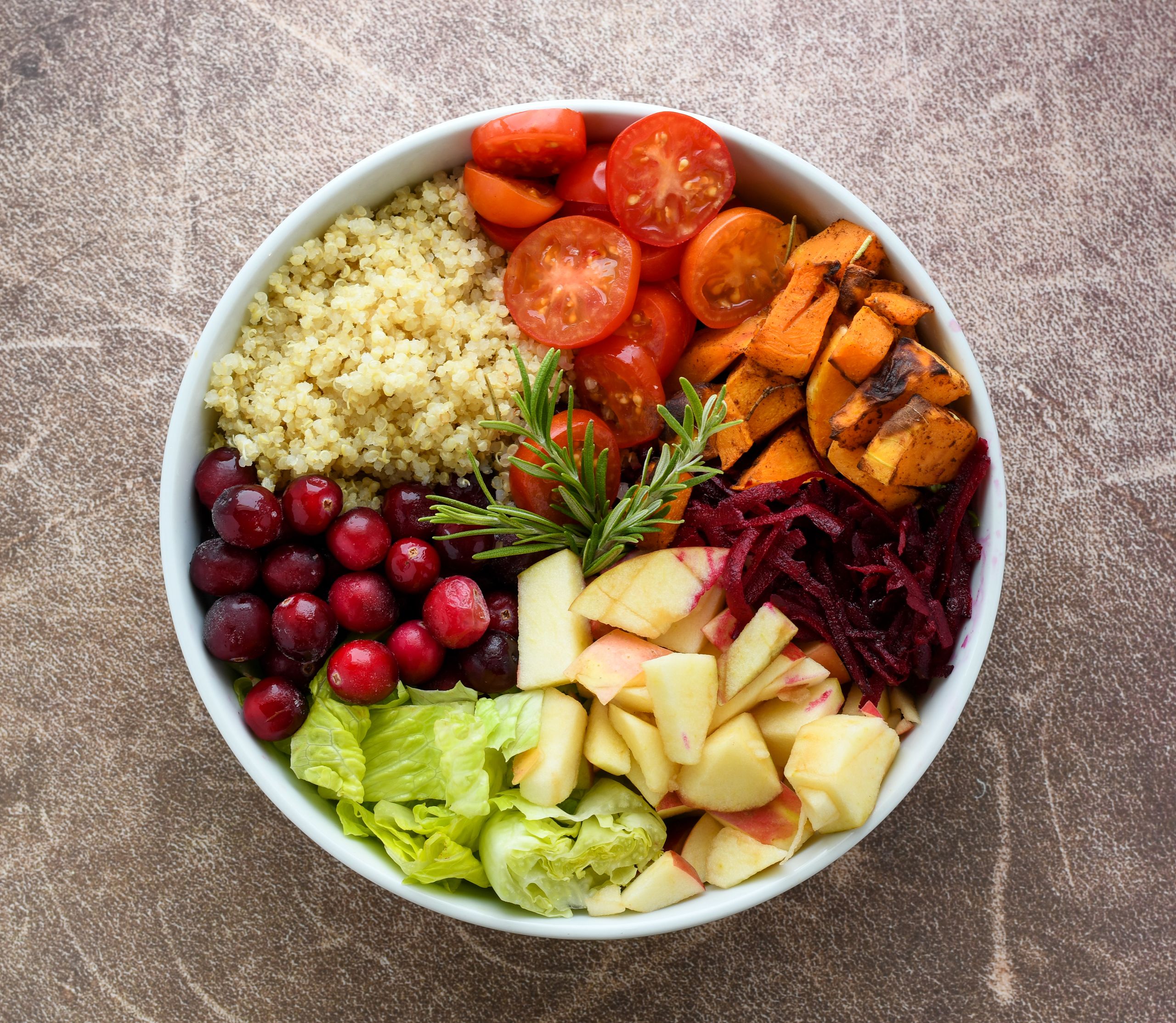
For me, the healthiest gluten-free diet is one made of whole foods that were never meant to contain gluten in the first place. Rice, quinoa, buckwheat, millet, potatoes, legumes, fruit, vegetables, eggs, fish, nuts, seeds, and naturally gluten-free dairy don’t need a “gluten-free” badge because gluten was simply never part of their molecules. When most of your plate comes from this kind of food, you sidestep the entire problem of reformulated, fortification-poor, ultra-processed substitutes almost by default.
Gluten-free bread and pasta can definitely have a spot in your life, especially for convenience, cultural traditions, and comfort. They’re part of what makes this way of eating truly manageable day to day. The key is in your foundation: when whole foods make up most of your meals, and packaged substitutes fill in the gaps, you get both protection from gluten and real nourishment, all coming together comfortably on the same plate. Stay with me, and we will discuss the rule of 80/20 further in this post.
The Effortless Whole-Food Plate
Some days you want a proper recipe. Other days you just want dinner to happen without a decision-making meltdown. Here’s the shortcut I use when I need something nourishing on the table fast:
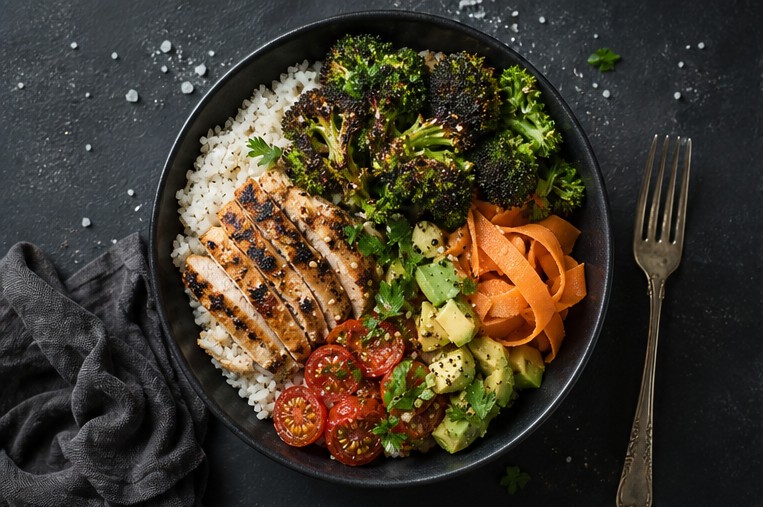
- Start with a base you don’t have to think twice about. Cooked rice, quinoa, sweet potato, or plain potatoes are naturally gluten-free and need zero label-checking.
- Add a protein without overthinking it. Eggs, canned fish, a rotisserie-style chicken, tofu, or a tin of beans all work. Beans and lentils are a double win because they bring fiber along with the protein.
- Fill at least half the plate with vegetables, cooked or raw, fresh or frozen. Frozen vegetables are just as nutritious and take away the pressure of “using them before they go off.”
- Add a fat that does some work for you. Olive oil, avocado, a handful of nuts, or seeds all support nutrient absorption, particularly for the fat-soluble vitamins in those vegetables.
- Finish with something acidic or fresh, like a squeeze of lemon, a spoon of yogurt, or fresh herbs, to lift the whole plate without a packet sauce.
None of this requires a special gluten-free aisle. That’s the beauty of this point.
Reading Labels
An ingredients list tells you how a product was actually made. A short list with recognizable names- rice flour, eggs, olive oil- means the product stayed close to its whole-food origins. A long list packed with gums, isolates, and numbers means it went through several rounds of industrial reformulation to hold its shape and texture without gluten. Neither version makes you wrong for buying it, but knowing which one you’re holding gives you real information instead of relying on whatever the front of the box wants you to believe.
This matters even more once you know what gluten-free products tend to get wrong at a nutritional level. So when you check a label, you’re not just confirming the product is gluten-free. You’re checking what replaced the gluten, and whether that trade-off works for you.
Your Supermarket Guide
Look at how much reconstruction went into the product. A short ingredients list with recognizable names generally means the food’s structure stayed closer to intact. A longer list, especially one carrying starches, gums, or isolates, tells you the manufacturer had to rebuild that structure significantly to compensate for the missing gluten.
Check where protein sits on the nutrition panel. Many gluten-free breads and pastas have less protein than their wheat-based versions. If you eat these often, get your protein from elsewhere too: eggs, fish, legumes, meat, dairy.
Look for fortification. In the UK and much of Europe, wheat flour is legally fortified with iron and B vitamins. Many gluten-free alternatives lack that same fortification. Seeing “fortified with iron” or “with added thiamine” on a label is genuinely useful information, not just marketing.
Notice added sugar as information. Gluten-free baked goods often add sugar to compensate for texture and flavor lost without gluten.
Check the price per 100g, not per pack. Gluten-free bread and other staples often have smaller packages and cost close to four times as much as their regular equivalent.
Where the 80/20 Rule Fits In
Here’s something I think deserves its own space, because everything I’ve shared so far could easily read as a lot of pressure, and that’s the last thing I want to leave you with. I know life is genuinely busy. Some weeks are calm enough to cook from scratch every night, and other weeks you’re running on fumes, juggling work, family, appointments, and just trying to keep everyone fed.
That reality is exactly why I build my eating around an 80/20 rhythm: roughly 80% of what fills my plate comes from whole, naturally gluten-free foods, and the other 20% has room for convenience meals, packaged treats, and yes, cake.
There is always a place for cake. I say that sincerely, not as a throwaway line. Celebrations, comfort, culture, and joy are part of what food is for, and a diet that leaves no room for any of that isn’t one most people can live with for very long, let alone happily.
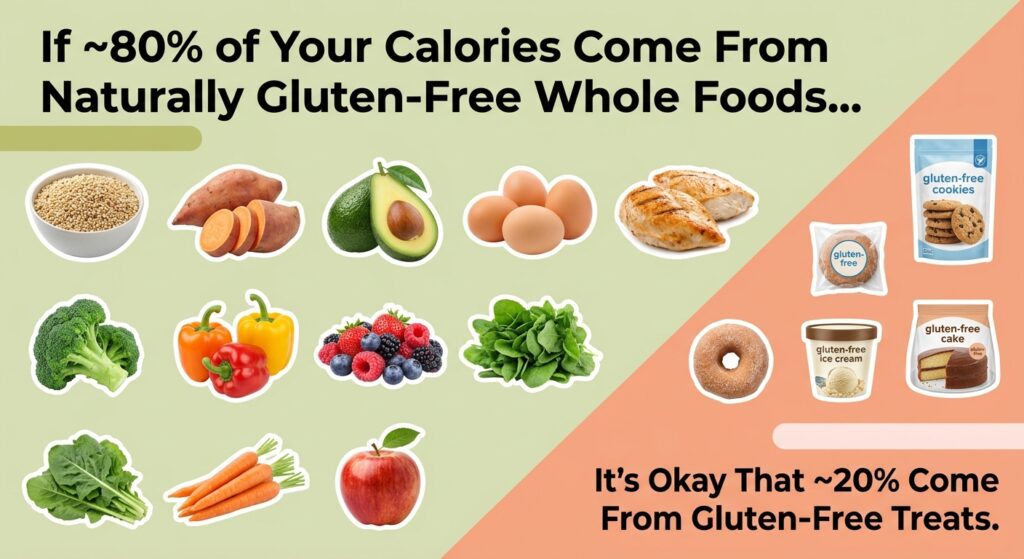
What makes this genuinely workable is something worth sitting with for a moment: our bodies are remarkably capable of recovering. When you have a day, or even a stretch of days, where the food choices lean less nourishing- a packet of biscuits at your desk, a processed ready meal after a long shift, dessert at a wedding- your body doesn’t spiral into crisis over it. It processes what it’s given, adjusts, and steadies itself again, especially once you return to the whole foods that make up the bulk of your week. That resilience is real, and it’s one of the most reassuring things I learned to trust as I built my own relationship with food.
The key is to keep those occasional, less-nutritious meals in their proper place, a smaller slice of the week, instead of turningit into your everyday routine. When whole foods are your go-to most of the time, your body gets the steady foundation of protein, fiber, and micronutrients it needs, and those treats or quick meals can be exactly what they’re meant to be: There is always a place for a cake!
So, What is The Healthiest Gluten-Free Diet?
At the end of the day, the healthiest gluten-free diet isn’t the most restrictive one, and it isn’t the one with the most impressive-looking free-from packaging in your cupboard. It’s the one you can sustain, that leaves you feeling energized rather than depleted, and that still lets you enjoy a meal with people you love without turning food into a source of constant vigilance.
Building your plate around whole, naturally gluten-free foods, and treating packaged substitutes as a helpful convenience rather than the backbone of your diet, gives you both safety and genuine nourishment. That’s not a trend or a wellness buzzword. It’s simply what the evidence, and my own kitchen, keep showing me.
FAQs
Are gluten-free foods fortified with vitamins and minerals?
No, most commercial gluten-free foods are fortified or enriched with vitamins and minerals. Unlike conventional wheat flour and grain products, which routinely undergo mandatory enrichment with B-vitamins (like folic acid and thiamin) and iron, equivalent processed gluten-free substitutes rarely add these missing nutrients back.
Are naturally gluten-free foods different from gluten-free substitute foods?
Yes, the naturally GF foods include fruit, vegetables, legumes, eggs, dairy, meat/fish, and grains such as rice, quinoa, and buckwheat. At the same time, manufactured GF breads, biscuits, cereals, and similar products are formulated replacements.
Is gluten-free bread considered ultra-processed?
Nearly 91% of packaged gluten-free products on UK supermarket shelves are classified as ultra-processed (NOVA Group 4), according to my own primary research dissertation analyzing UK supermarket shelves (2026). However, processing classification depends on the formulation and ingredients; “gluten-free bread” is a category, not one single recipe. Check the individual product instead of assuming every loaf falls into the same NOVA group.
Why are gluten-free products often more expensive?
Gluten-free products require specialized ingredients and manufacturing processes to
replace the structure gluten normally provides, which drives up production costs,
sometimes bringing staples like bread close to four times the price of their regular
equivalent.